


Basmati vs Non-Basmati Rice: Which Is More Profitable for Indian Farmers? (2026 Guide) By Team Omkar seeds

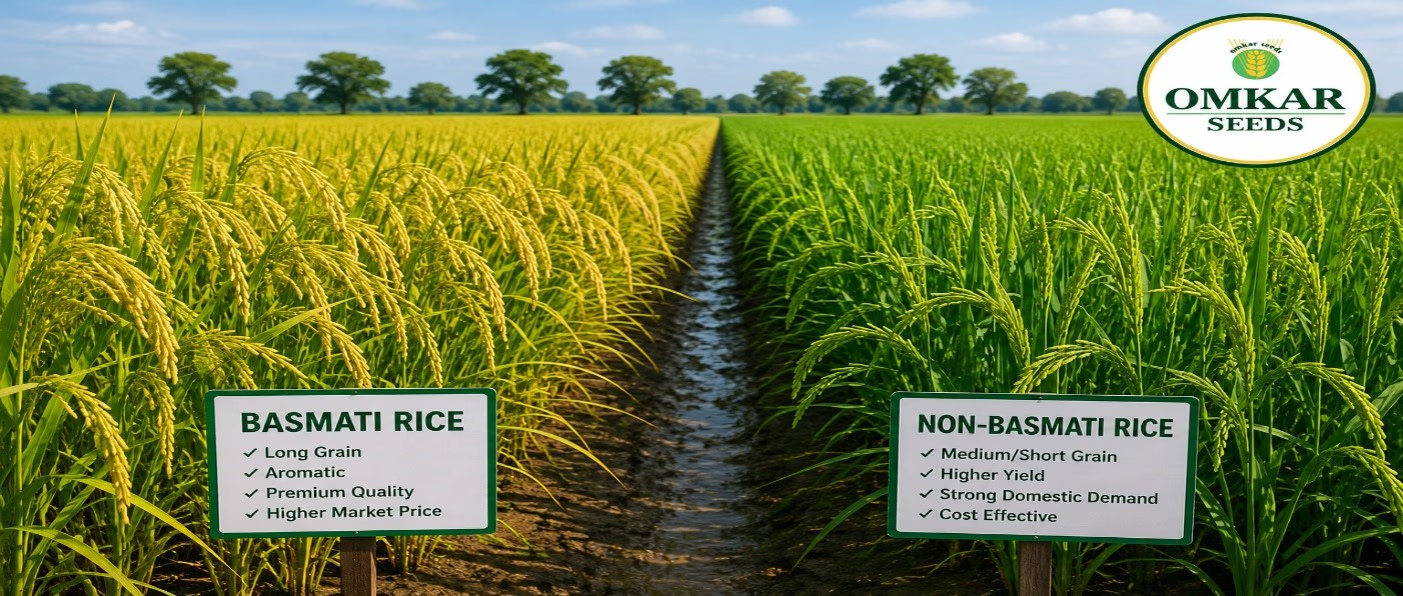
Basmati vs Non-Basmati Rice: Which Is More Profitable for Indian Farmers? (2026 Guide)
By Team Omkar Seeds
Introduction
Rice is the backbone of Indian agriculture, supporting millions of farming families and contributing significantly to the country’s food security and export economy. Every Kharif season, one of the most important decisions farmers make is whether to cultivate Basmati rice or Non-Basmati rice.
While many growers believe that Basmati always generates higher profits because of its premium market price, others prefer Non-Basmati because of its higher productivity and comparatively lower market risk. In reality, profitability depends on several interconnected factors including production cost, market demand, grain quality, yield, irrigation availability, and the marketing channel available to the farmer.
This guide explains the major differences between Basmati and Non-Basmati rice and the factors farmers should consider when selecting a rice type for their farming conditions.
Understanding Basmati Rice
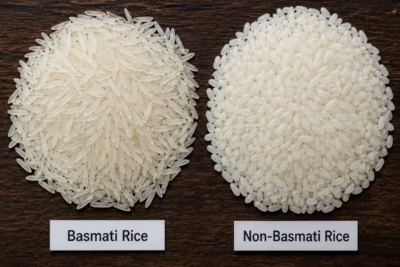
Basmati is a premium aromatic long-grain rice cultivated mainly in the Indo-Gangetic plains. It is internationally recognized for its fragrance, grain elongation after cooking, and superior eating quality.
India produces several well-known Basmati varieties such as:
- PB-1121
- PB-1509
- PB-1718
- PB-1847
- CSR-30
These varieties are mainly grown in Haryana, Punjab, Western Uttar Pradesh, Uttarakhand, Himachal Pradesh, Delhi, and parts of Jammu & Kashmir.
The strong export demand for Indian Basmati often enables farmers to obtain premium prices when grain quality meets market standards.
What Is Non-Basmati Rice?
Non-Basmati rice includes all rice varieties that do not possess the characteristic aroma and grain quality of Basmati. These varieties are cultivated throughout India and form the foundation of the country’s domestic rice supply.
Popular Non-Basmati varieties include:
- PR-126
- PR-131
- Swarna
- MTU-1010
- Samba Mahsuri
- IR-64
These varieties are widely preferred because they generally produce higher yields and perform well under diverse agro-climatic conditions.
Basmati vs Non-Basmati: Key Differences
| Feature | Basmati Rice | Non-Basmati Rice |
|---|---|---|
| Grain quality | Long slender and aromatic | Medium or bold grain |
| Selling price | Usually higher | Moderate |
| Yield potential | Moderate | Higher |
| Export demand | Very high | Moderate |
| Domestic demand | Good | Extremely high |
| Market volatility | Higher | Lower |
| Quality requirement | Very strict | Comparatively flexible |
Which Gives Higher Yield?
Yield is one of the biggest deciding factors for farm profitability.
Most modern Non-Basmati varieties produce considerably more grain than Basmati under similar management practices.
Under good crop management:
- Basmati generally produces around 40–60 quintals per hectare.
- Non-Basmati commonly produces 55–75 quintals per hectare, depending on the variety and local conditions.
Therefore, farmers seeking maximum physical production often prefer Non-Basmati cultivation.
Which Fetches Better Market Price?
This is where Basmati gains a significant advantage.
The unique aroma, cooking quality, and export demand of Basmati allow it to command a premium price compared with ordinary rice. However, this premium is only realized when farmers maintain grain purity, harvest at the proper maturity stage, and avoid quality deterioration during storage and handling.
Non-Basmati rice generally sells at lower prices but benefits from consistent domestic demand and procurement in many regions.
Cost of Cultivation
Both rice types require careful crop management, but Basmati demands greater attention to quality.
Major expenditure includes:
- Certified seed
- Land preparation
- Fertilizer application
- Weed management
- Irrigation
- Plant protection
- Harvesting
- Post-harvest handling
In Basmati cultivation, maintaining varietal purity and grain quality is equally important as achieving good yield.
Export Opportunities
One of the strongest advantages of Basmati cultivation is its export market.
Indian Basmati is exported to numerous countries including:
- Saudi Arabia
- Iran
- Iraq
- United Arab Emirates
- United States
- United Kingdom
- Kuwait
- Oman
The premium international demand often results in higher returns compared to conventional rice, provided export demand remains stable. India continues to be the world’s leading exporter of Basmati rice.
Market Risks
Although Basmati offers attractive prices, farmers should also understand its risks.
Basmati prices can fluctuate because they depend heavily on:
- Export demand
- International trade policies
- Quality standards
- Weather conditions
- Global supply
Non-Basmati generally experiences less price volatility because of strong domestic consumption and government procurement mechanisms in several states.
Which Farmers Should Choose Basmati?
Basmati is generally suitable for farmers who:
- Farm within approved Basmati-growing regions
- Have access to quality certified seed
- Can maintain proper crop management
- Have access to reliable buyers or exporters
- Are willing to focus on grain quality rather than maximum yield
Which Farmers Should Choose Non-Basmati?
Non-Basmati is often suitable for farmers who:
- Want higher grain production
- Prefer a more stable market
- Sell primarily in domestic markets
- Have access to procurement systems
- Prioritize lower marketing risk
How to Increase Profit Regardless of Variety
Regardless of whether a farmer chooses Basmati or Non-Basmati, profitability depends on good agricultural practices.
To maximize returns:
- Purchase certified seed from trusted companies
- Follow the recommended sowing window
- Conduct soil testing before fertilizer application
- Apply balanced nutrients
- Control weeds during the critical growth period
- Monitor pests and diseases regularly
- Harvest at the correct maturity stage
- Store produce properly to preserve grain quality
- Sell when market conditions are favorable
Basmati or Non-Basmati: Understanding the Choice
The question is not simply “Which rice is better?” but rather “Which rice is better suited to your farm?”
For farmers in Haryana, Punjab, and Western Uttar Pradesh with suitable soils and access to premium markets, Basmati rice can provide higher price realization, although its yields may be comparatively lower.
For farmers seeking dependable production, higher yields, and lower market uncertainty, Non-Basmati rice remains an economically viable option.
Ultimately, long-term profitability depends on choosing the right variety for local conditions, using certified seed, and following recommended crop management practices.
Conclusion
Basmati and Non-Basmati rice each have different production characteristics, market opportunities, and quality requirements.
Basmati offers long slender aromatic grains and strong export demand. Non-Basmati varieties generally offer higher production and strong domestic demand. The final returns for farmers depend on factors such as yield, selling price, production cost, grain quality, market access, and local farming conditions.
Farmers should consider these factors carefully before selecting a rice variety for the coming season.
At Omkar Seeds, we believe that every successful harvest begins with high-quality seed. Selecting the right variety and adopting scientific farming practices can help farmers improve productivity, grain quality, and overall profitability.
References
- Agricultural and Processed Food Products Export Development Authority (APEDA). Basmati Rice – Production, GI Area and Export Statistics.
- Agricultural and Processed Food Products Export Development Authority (APEDA). Non-Basmati Rice Overview and Export Information.
- Indian Council of Agricultural Research (ICAR). Basmati Rice Varieties and Production Technologies.
- ICAR–Indian Institute of Rice Research (IIRR), Hyderabad. Package of Practices for Rice Cultivation.
- Punjab Agricultural University (PAU), Ludhiana. Package of Practices for Kharif Crops.
- CCS Haryana Agricultural University (CCS HAU), Hisar. Package of Practices for Kharif Crops.
- Food and Agriculture Organization (FAO). Rice production and market information.

